
## blog — cat tech-hiring-budget-2027-recruitment-fees.md
Planning your 2027 tech hiring budget? Here's what a recruitment fee really pays for
· BE Consultancy Group
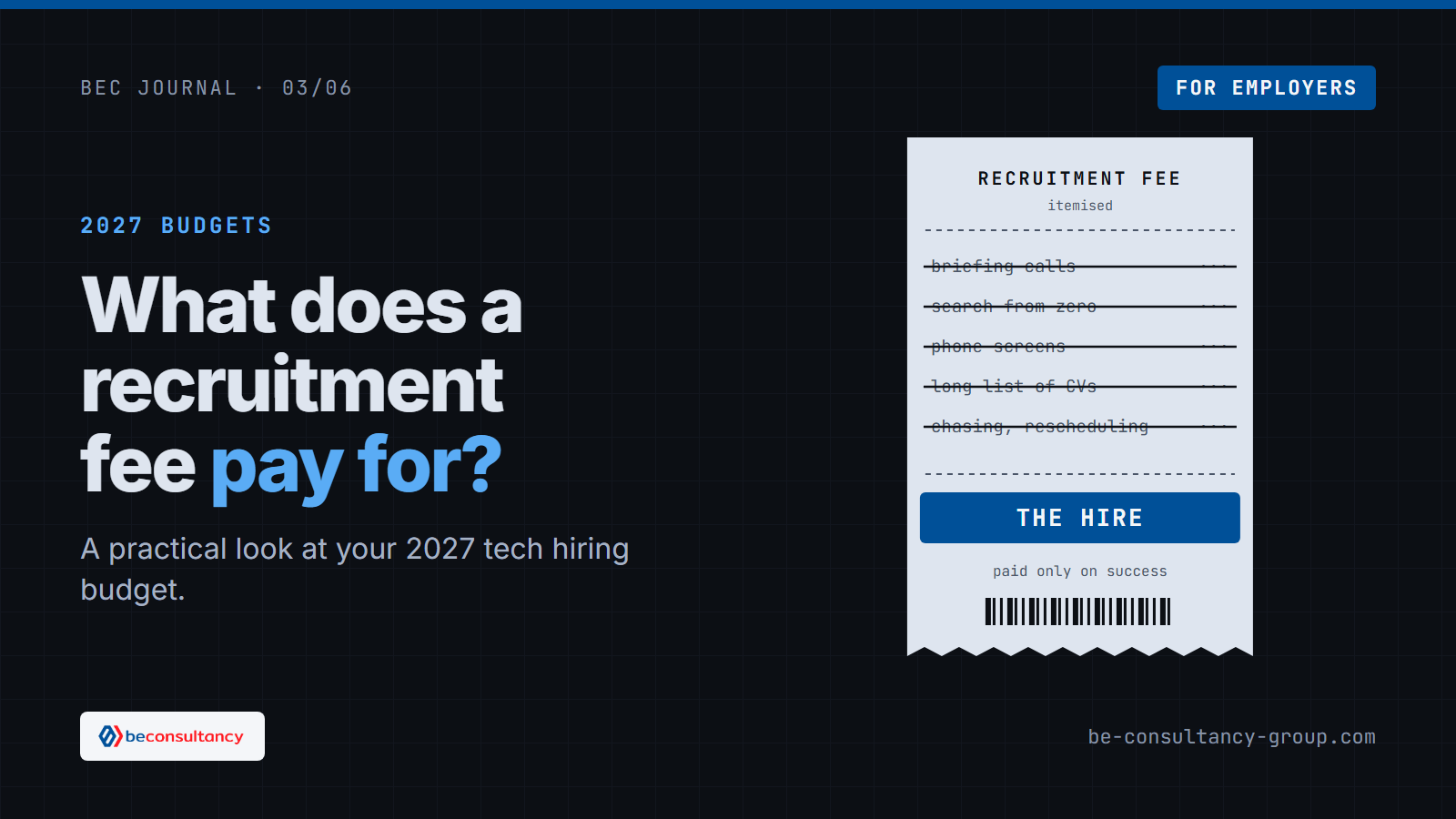
December is budget season. Somewhere between the headcount plan and the finance review, someone puts a line in a spreadsheet called "recruitment costs" and multiplies the number of planned hires by whatever the agencies charged last year.
That number deserves a closer look. Not because recruiters are expensive, but because most budgets don't separate what you're actually buying from what you're paying for by habit.
What a traditional agency fee covers
When you brief a traditional agency, the fee pays for a long chain of work, most of which happens after your call:
- The briefing. Calls to understand the role, often more than one.
- The search. Finding people who might fit, from scratch, for your vacancy.
- The first screen. Phone calls to see who is interested and available.
- The long list. CVs sent to you, many of which you'll reject in seconds.
- The coordination. Interviews, feedback, chasing, re-scheduling.
- The risk. On contingency, the agency is paid only if it fills the role, so the fee also covers all the searches that went nowhere.
All of that work is real. The question for your budget is how much of it you actually need for each hire.
Pay for the hire. Not for the hunt that happens after you call.
The cost nobody budgets for: the open seat
The biggest hiring cost in most engineering teams doesn't appear in the recruitment line at all. It's the time a senior seat stays empty.
While the role is open, someone covers it. Usually that's your strongest engineers, who are now doing two jobs. Roadmap items slip. Incidents take longer. And the longer a senior role is open, the more likely it is that someone else on the team starts looking too.
When you set your 2027 budget, it's worth asking a different question for each planned senior hire: what would it be worth to have this person a month earlier?
Where companies overspend
Looking at hiring through that lens, a few patterns stand out:
Paying for searches that start from zero
If every agency starts each vacancy from a blank page, you're paying for that search every time, often several times in parallel across suppliers.
Paying for volume instead of evidence
A long list of CVs feels like progress. In reality, every CV you read is time your engineering managers aren't spending on their teams. Five strong-looking profiles with no evidence behind them cost more than one well-documented one.
Exclusivity that removes options
Some agencies ask for exclusivity in exchange for priority. That can make sense for a hard-to-fill executive role. For most senior engineering roles, it narrows your access at exactly the moment you need it widest.
A different model: start from the candidate
At BE Consultancy Group we built our model around the idea that the expensive part of recruitment, finding and vetting senior people, can be done before a vacancy exists.
We represent senior IT professionals who have asked us to represent them. Our senior recruiters interview each of them in depth and screen them technically for their stack. Then our engine matches them every day against vacancies companies have already published, and a senior recruiter checks every match.
When one of ours fits one of yours, you receive an anonymised profile and a one-page summary of exactly what our vetting covered. You judge the fit in minutes. If you want to meet the person, you sign simple terms. You pay only when you hire, with a replacement guarantee behind it.
Because the search and the vetting are already done when we contact you, our fee sits well below what you're used to. We'd rather earn your second and third hire than a big margin on the first.
Five questions for your 2027 hiring budget
- How many of next year's hires are senior, specialist roles? Those are where the cost of an open seat is highest.
- Which of those roles can you publish now? A published vacancy is how candidate-first recruiters find you.
- What are you paying for that you don't use? Briefing calls, long lists, exclusivity.
- How fast can you decide? A shorter interview process is the cheapest hiring improvement there is.
- Do your supplier terms allow success-only partners? If your preferred supplier list is closed, check whether it can include partners who only charge on a hire.
None of these questions require a bigger budget. They require spending the one you have on the part of recruitment that actually produces a hire.
Hiring senior IT talent in 2027? Tell us what you're hiring for. If we represent a match, you'll know fast. → be-consultancy-group.com/employers