
## blog — cat december-hiring-window-senior-engineers.md
The December window: why your best senior hire for 2027 is decided before January
· BE Consultancy Group
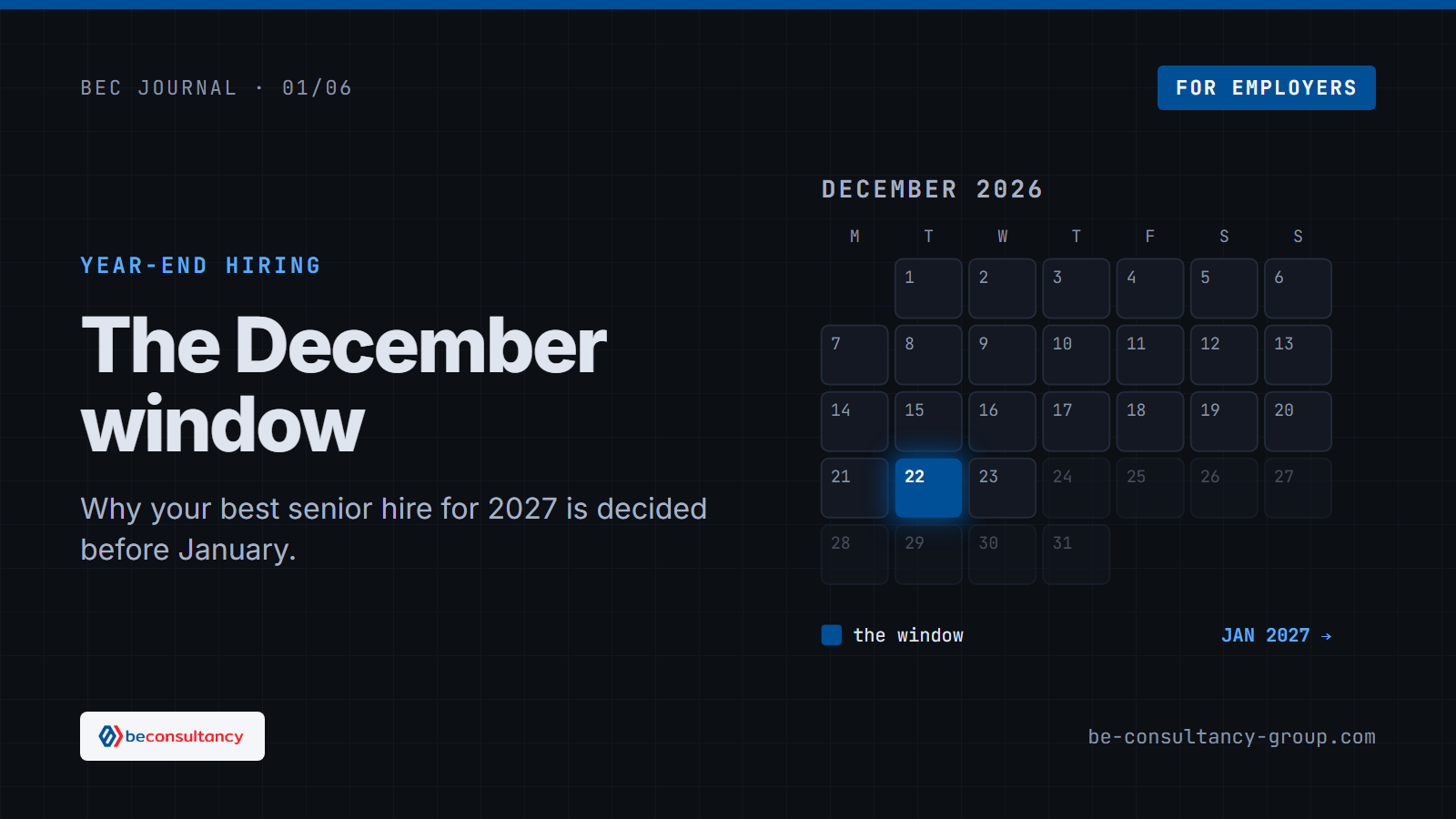
Every year the same thing happens. Hiring slows down in late November, budgets get frozen "until the new year", and recruiting teams switch to planning mode. Then January arrives, every company opens its vacancies at once, and the senior engineers you wanted have already said yes to someone else.
The reason is simple. Senior people don't decide to move in January. They decide over the holidays, and they start acting on that decision in the weeks before.
Why December is when senior engineers decide
For most experienced engineers, the end of the year is the first moment in months to step back. Projects pause, the year-end review lands in their inbox, and the bonus question is either answered or about to be. Add a few days off and a family dinner where someone asks "so, are you still happy there?", and a vague feeling turns into a plan.
What they rarely do in December is apply. Senior people don't spray their CV across job boards, and most won't risk their current employer finding out they're looking. Instead they quietly ask a recruiter they trust, a former colleague, or a representative what's out there. By the time your January job ad goes live, the best of them are already in conversations.
The best candidates don't start looking in January. They start deciding in December.
The cost of the "we'll restart in January" plan
Pausing hiring at year end feels prudent. In practice it does three things to your 2027 plan:
- It puts you at the back of the queue. In January you compete with every company that also waited. Response rates drop, interview calendars clog, and offers get countered.
- It stretches the vacancy. A role that could have been filled by February is still open in April. The work doesn't wait: your existing team covers it, and that is usually the most expensive way to fill a gap.
- It hides a decision you've already made. If the role is in next year's plan, you've decided to hire. Waiting only changes who you get.
None of this means you should sign contracts in December for roles that aren't approved. It means the work of finding the right person should start before the budget formally opens.
What to do in November and December
Publish the vacancy now, even with a later start date
A published role is a signal. It tells the market, and the people who represent senior engineers, exactly what you need. You can state a start date in Q1 and still begin conversations now. Many senior engineers have notice periods to work through anyway, so a December conversation often means a February or March start date.
Make the role description specific
Senior engineers read vacancies the way they read code: they look for evidence. "Cloud experience" says nothing. "You'll own our move from self-managed Kubernetes to a managed platform, with a team of four" says a lot. Specific roles attract specific people, and they make matching faster for everyone who works with you.
Shorten your own process before you need it
December is a good time to look at your interview loop. How many rounds do you run for a senior role? How long between the first conversation and an offer? Senior candidates often run two or three processes at once. The company that moves clearly and quickly is usually the one that wins, even with a smaller offer.
Agree who decides
The most common reason good candidates walk away in Q1 is silence while internal approval catches up. Before the holidays, agree who signs off a senior hire, what the salary or day-rate range is, and what happens if the right person appears earlier than planned.
Where candidate-first recruitment fits in
At BE Consultancy Group we work the other way round from a traditional agency. We start from senior IT professionals who have asked us to represent them, people our senior recruiters have interviewed and technically screened, and we match them every day against vacancies companies have already published.
That model is built for exactly this window. The engineers we represent tell us when they're thinking about a move, often well before they'd ever apply anywhere. Their profiles stay anonymous until a company signs our terms because it wants them, and they're told every time. That's why they trust us with a search they'd never run in public.
For you, it means three things in December:
- You hear about people who aren't on the market yet. If one of ours fits a role you've published, you receive an anonymised profile and a one-page summary of exactly how we vetted them.
- You can judge a fit in two minutes. No briefing calls, no long lists. If it isn't right, you've lost nothing.
- You only pay when you hire. No retainers, no exclusivity. Keep your preferred suppliers; we only appear when we represent a match.
A simple year-end checklist
Before you close the laptop for the holidays:
- Publish every senior role that is in your 2027 plan, with a realistic start date.
- Rewrite each role description around the actual work in the first six months.
- Cut one step from your senior interview process.
- Agree the approval path and the range for each role.
- Tell the people you trust to send you candidates that you're open to talking in December.
The companies that land strong senior engineers in Q1 rarely have bigger budgets. They simply started the conversation when the engineers did.
Hiring senior IT talent for 2027? Tell us what you're hiring for. If we represent a match, you'll know fast. → be-consultancy-group.com/employers